


Bambu Lab H3C Combo 3D Printer
Couldn't load pickup availability
Eco Seçeneklerimiz


Tool Changer.
Game Changer.
Welcome to the new era of 3D printing!

Floral Frame - CMYKW Color Mixing
Nine PrintTools. One extraordinary print. The Bambu Lab H3C brings color, material versatility, and intricate detail together in a single creation. Five PrintTools blend CMYKW into full-spectrum color, one handles water-soluble PVA supports, and three add unique textures using PLA Silk and Wood. Together, they create a stunning floral design with vibrant colors, intricate details, and a beautiful sheen that brings every petal to life.

SVEINS Ridgeline Gather Bag - Multi-color TPU
Futuristic design meets outdoor functionality. Combining TPU materials with different hardness levels, the body offers flexibility where it needs to stretch (75A), structure where it needs support (95A), and cushioning where it meets the ground (90A). Beneath the surface, Cross Zag infill adds visual depth and a responsive feel, bringing comfort, function, and design together in a single print.

BounceBerry X Trainer - Multi-material Flexible
75A TPU up top, while breathable Cross Zag infill promotes airflow. High-rebound blocks in the midsole provide responsive cushioning, and an X-shaped arch in the outsole adds stability during quick changes in direction. Together, these features deliver the breathability, flexibility, support, and responsiveness you'd expect from everyday footwear.

Maker Watch - Mixed Nozzle Sizes
A watch is normally a few dozen parts and a long evening. This one lifts off the plate as one body: dial, case, and band already together. What's left is a short finish, not a build. Bambu Lab H3C changed materials and nozzle sizes mid-print: 0.2 mm for sharp indices, 0.4 mm for a case that holds its shape, and a TPU nozzle for a 75A band that bends like a band should. Printed as one. Finished in minutes.

FROSTSPINE Dragon Bust - Print-in-Place Spine
What looks like a hundred individual parts is actually one seamless print of three parts. This bio-inspired spine combines three materials: PLA for a rigid frame, 90A TPU to cushion each ball joint, and 75A TPU that runs through the structure like ligaments, allowing natural, fluid movement. Three materials, one print, zero assembly. That's Swaptek™.

Hinge Lamp - Multi-Material Damper Hinge
All the magic is in the hinge. It prints as one piece: a 75A TPU cushion sandwiched between rigid shells, springy under the thumb and good for thousands of adjustments. A 0.2 mm nozzle prints the ratchet, so every click lands smooth, not gritty. You'll adjust it just because it feels good.

Mecha Hammerhead Shark - Printed Reduction Gear Set
Anyone can print a shark. Making it swim is the hard part. Inside sits a fully printed reduction gear train, driven by a Makers' Supply motor kit, offsetting head and tail so it swims instead of wags. The shape borrows from future vehicle design: supercar lines, shark anatomy, both shaped by what moves through them.
At a glance
 9-Material Printing, Low Purge Waste
 6-Second Material Switching*
 Prints Ultra-soft TPU 3× Faster*
 Fully Enclosed Filament Storage & Feeding
 Expandable Crafting Tools*

Swaptek™ - 6-second print-to-print material switch
Nine PrintTools, each with its own dedicated filament path and heater, keep every material loaded, preheated, and ready to print. No need to retract one filament before loading another. With an optimized design, fine-tuned parameters, and active preheating, switching between PrintTools takes as little as 6 seconds.
 3.4s Tool Change
 0.038g Low Purge*
 Multi-process
Preheat the next nozzle before you need it.
Heating a nozzle usually means waiting. Active Pre-Heat looks ahead to the next tool change and warms the incoming nozzle while the current one is still printing, so the new material starts laying down within 6 seconds.

Soft TPU, up to 3× faster*, without jams*.
Printing soft TPU has traditionally been slow because flexible filament can buckle before reaching the nozzle, limiting extrusion speed. FlexFeed supports both 1.75 mm and 2.85 mm filament, with dedicated 2.85 mm TPU providing greater resistance to buckling and higher volumetric flow. The result? Reliable printing with TPU as soft as 75A at up to 3× the flow rate of traditional printers.

FlexFeed switches seamlessly between 1.75 mm and 2.85 mm filaments. A cam-driven mechanism, powered by a PMSM motor, keeps tension precise and consistent, so every extrusion stays rock-solid.

SVEINS Ridgeline Bag

BounceBerry X Trainer
Speed where you want it. Detail where it matters.
The dial, case, and flexible TPU band are printed together as one piece. Fine dial details call for a 0.2 mm nozzle, the case is better suited to 0.4 mm, and the soft band requires a dedicated 0.4 mm TPU nozzle. Bambu Lab H3C can carry different nozzle sizes at once. Paired with Bambu Studio's new mixed-diameter toolpath planning algorithm, each nozzle prints at a layer height that suits it and plays to its strengths, without having to share a single layer height.

It's all about curiosity.
Watching a print come to life is part of the magic of 3D printing. That's why the rack retracts out of view, giving you a clear look inside the chamber. Pull up a chair, watch the first layer take shape, and enjoy the process. It's something that never gets old.

Print. Cut. Draw. Deboss. All in one machine, all on its own.
Swaptek isn't limited to PrintTools. Optional CutTool, DrawTool, DebossTool and more mount the same way and switch automatically. Multi-process projects no longer mean multiple machines, manual swaps, or repeated setups. One job, every process, hands off.

Deboss

Blade-cut

Draw

Foil-transfer

AMS 3H - Filament Management Built for Tool Changer
A fully enclosed, integrated filament management system built for Swaptek™: every roll stays sealed against moisture and feeds automatically into the PrintTool. A built-in 2-slot dryer takes extra care of the most hygroscopic filaments: PA, PET, and TPU.
 9-Slot
 85°C Dryer*
 Auto-Loading
No guesswork on loading.
No more manual loading. Drop a filament into any of the nine slots and the AMS 3H detects, routes, and engages it with the PrintTool automatically, across all 9 paths.

Drying, integrated into the print flow.
A dedicated 2-slot dryer sits right in the filament slots and works with Swaptek™, drying on demand or mid-print*, so prep never stalls production. It reaches 85°C*, enough for engineering-grade PA, PC, and carbon-fiber-filled filaments.


Dry

Moist
Nine materials, with room for more.
Most toolchangers limit the number of materials to their available tools. The Bambu Lab H3C goes further. Connect existing Bambu Lab AMS units through PrintTool No. 1 to support up to 24 filament spools, unlocking more colors and materials in a single print without changing your workflow. Already own an AMS? Simply connect it and expand your possibilities.

Filament storage, built in. Not hanging off.
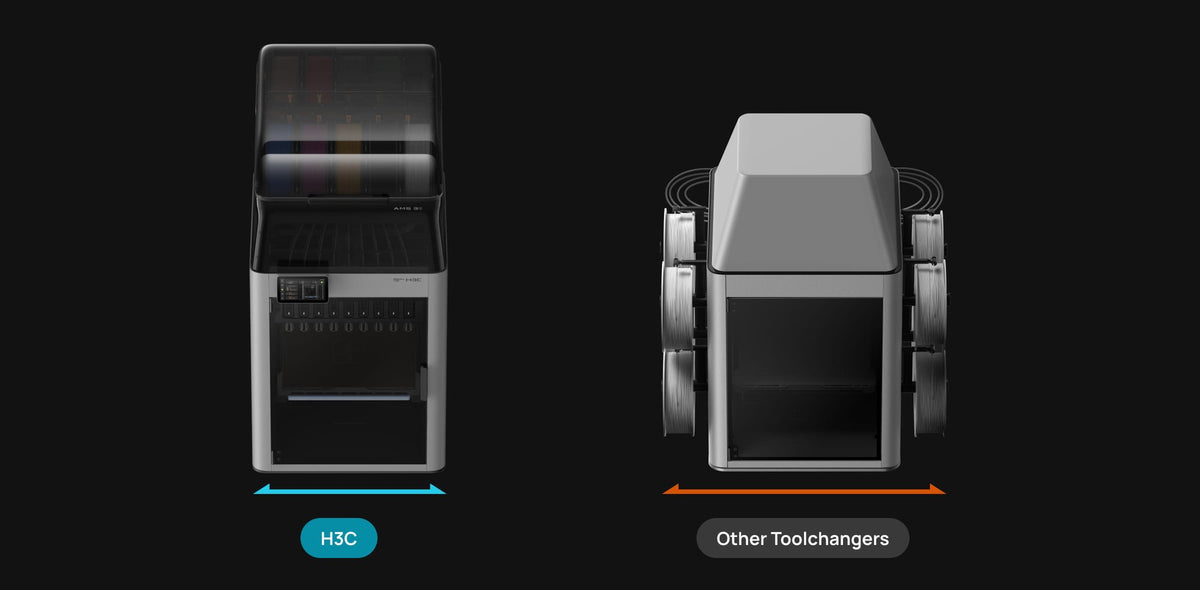
No spools hanging off the side, no dryer taking up valuable workspace. The Bambu Lab H3C integrates filament storage and drying into a clean, compact design, maintaining a footprint comparable to a single-nozzle printer. No external racks or exposed filament paths. Just one streamlined, all-in-one printing solution.

Flagship Performance. No Compromise.
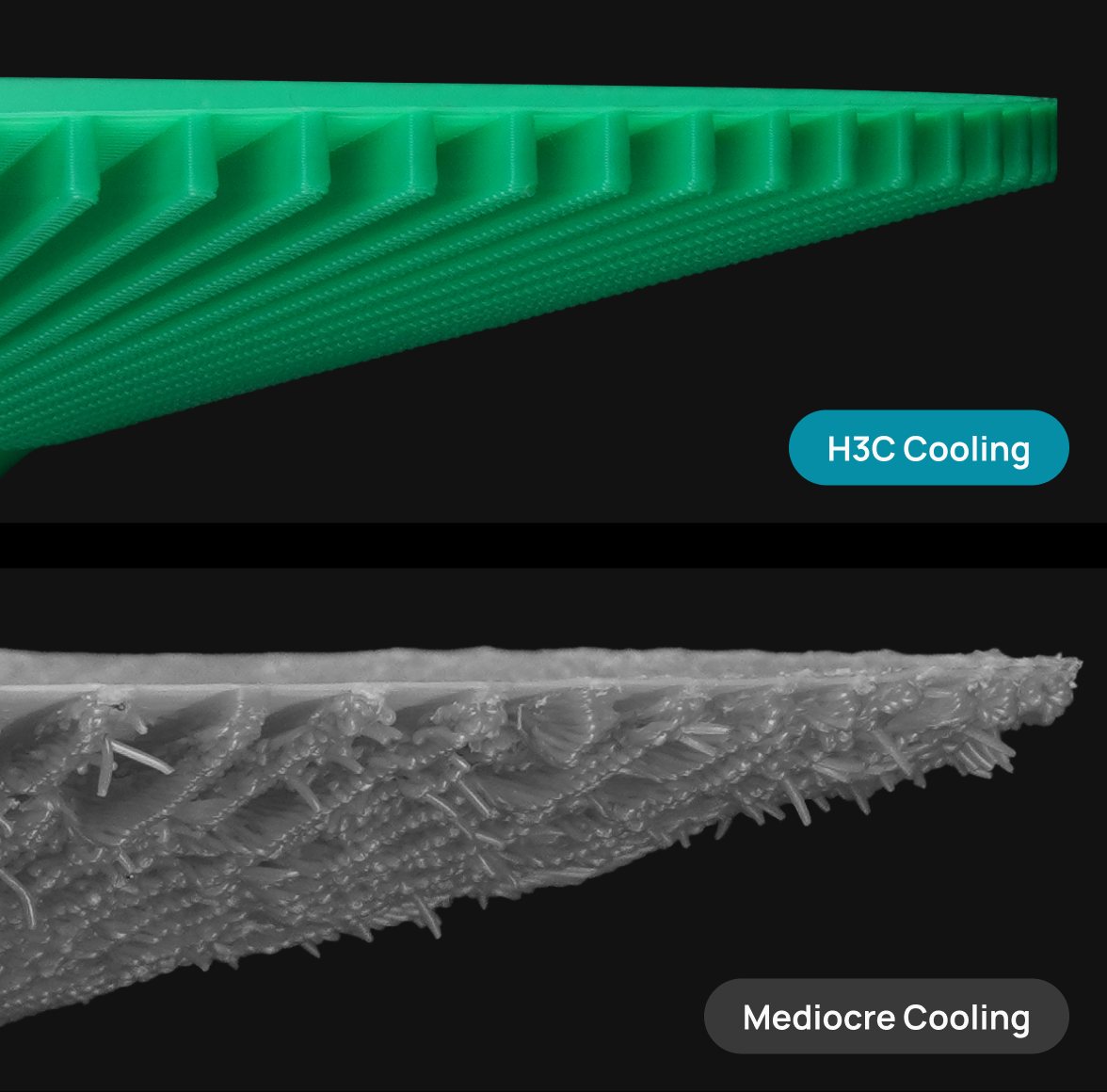
Behind the Bambu Lab H3C's advanced multi-material capabilities is a foundation engineered for precision and performance. Cross-flow cooling delivers cleaner overhangs, a 65°C heated chamber helps minimize warping with engineering-grade materials, and an advanced motion system maintains fine detail even at high speeds. Complex prints demand more from your printer. The Bambu Lab H3C is built to deliver.
Lighter head. Faster prints. Same precision.
The toolhead and X-axis assembly are 40% lighter*, reducing inertia for faster, more precise movement. With acceleration reaching 25,000 mm/s² and travel speeds up to 1,400 mm/s, the Bambu Lab H3C delivers exceptional speed while minimizing vibrations and ringing that can affect print quality.

50 μm motion accuracy. Held for years, not weeks.
For projects where precision matters, from engineering components to production runs, the optional Vision Encoder helps maintain accuracy over time. By providing an absolute optical reference, it enables recalibration to compensate for mechanical wear and drift, restoring motion accuracy to under 50 μm across the build volume. Precision you can rely on, print after print.

Cooled at every level. Print clean, even in summer.
Effective cooling is essential for consistent print quality. That's why the Bambu Lab H3C features four layers of cooling working together. A CFD-optimized part cooling fan and dual auxiliary fans help maintain clean overhangs and bridges, even at high speeds. A dedicated PrintTool fan maintains thermal stability during extended printing and frequent PrintTool changes, while a chamber fan draws in cooler air to help regulate internal temperatures*. Together, these systems deliver consistent cooling and reliable print quality across changing ambient temperatures.

Engineered for High Temperatures, From Nozzle to Chamber.
Engineering-grade filaments demand precise temperature control. The Bambu Lab H3C delivers with active dual-zone chamber heating up to 65°C, helping maintain consistent temperatures and minimize warping. All nine hardened-steel nozzles reach up to 350°C, supporting demanding materials such as ABS, PC, PA-CF, PET-CF, and more.


More Time Making. Less Time Tinkering.
The Bambu Lab H3C packs advanced technology into a surprisingly simple experience. Automation handles routine tasks, while AI helps make intelligent adjustments along the way. Whether you've been 3D printing for ten years or just ten minutes, the Bambu Lab H3C makes it easy to focus on what matters most: bringing your ideas to life.
Nine tools, calibrated automatically, every time.
With nine PrintTools working together, precision is essential. The Bambu Lab H3C automatically handles PrintTool docking calibration, offset compensation for accurate color and material alignment, and bed leveling before every print. No manual adjustments needed.

It watches, so you don't have to.
A full array of vision systems* watches from before the first layer to the last. Up front, the Bambu Lab H3C checks the chamber against your slicer setup and flags mismatches while they're easy to fix. Then its AI catches spaghetti, purge-bin jams, and clogs before they cascade. Check in whenever you like.

Find the fix, right on your screen.
The new HMS doesn't just throw an error code at you. It diagnoses the actual cause: narrowing it down, ranking the possibilities, and explaining what each one means in plain language. You see what's wrong, not what might be. Then MiniWiki walks you through the fix, right on the printer's screen. No QR codes. No phones. No flipping between the machine and a help page. Read the step. Do the step. Move on. Most issues resolved before your coffee gets cold.


Made to fit your space.
A 3D printer shouldn't take over your space; it should fit into it. Bambu Lab's official accessories make the Bambu Lab H3C feel like a natural part of your workspace.
Lift it up. Tidy it up.
Bambu Station L lifts the Bambu Lab H3C to a comfortable working height: easier loading, maintenance, and monitoring, no stooping. Underneath, dedicated storage keeps tools, spare filament, and essentials right where you reach for them.

Clean air. No compromises.
Working next to a printer shouldn't mean breathing what it makes. The Bambu Lab E1 pairs with your Bambu Lab H3C and kicks in filtration the moment a print starts.

It captures what you can smell, and everything you can't:

VOCs

PM2.5

0.3μm Microplastics
The result? Cleaner air, fewer unwanted odors, and a more comfortable workspace. Keep your creativity flowing while the E1 helps keep the air cleaner.
What's in the box
| Bambu Lab H3C Combo | |
|---|---|
 Bambu Lab H3C | ✓ |
 Bambu Lab AMS 3H | ✓ |
 Printer Power Cord | ✓ |
 Dryer Module Power Cord | ✓ |
 Bambu Bus Cable 6-pin | ✓ |
 Textured PEI Build Plate | ✓ |
 0.4mm PrintTool | 8 |
 0.4mm PrintTool (for 2.85mm filament) | 1 |
 Accessories Box | ✓ |
Specs
| Printing Technology | |
| Type | Fused Filament Fabrication |
| Body | |
| Build Volume (L * W * H) | 330*320*325 mm³ |
| Enclosure Type | Enclosed |
| Hotend Switching System | Bambu Lab SwapTek™ 9-Tool Switching |
| Chassis | Steel |
| Outer Frame | Plastic |
| Dimensions and Weight | |
| Package Dimensions | 600*630*700 mm |
| Product Dimensions | 493*571*587 mm |
| Recommended Installation Space | 593*1056*1306 mm |
| Net Weight | 36.28 kg (including the AMS 3H) |
| Toolhead | |
| Extruder Gear | Hardened Steel |
| Included Nozzle Material | Hardened Steel |
| Max Nozzle Temperature | 350 °C |
| Included Nozzle Diameter | 0.4 mm |
| Supported Nozzle Diameter | 0.2 mm, 0.4 mm, 0.6 mm, 0.8 mm |
| Filament Cutter | Built into the PrintTool |
| Expansion Options | Supports the CraftTool (CutTool, DrawTool, and more coming) |
| Supported Filament Diameter | 1.75 mm, 2.85 mm (Bypass feed only) |
| Extruder Motor | Bambu Lab high-precision brushless servo motor with planetary gearbox |
Expand tableCollapse table
| Heatbed | |
| Build Plate Material | Flexible Steel Plate |
| Included Build Plate Type | Textured PEI Plate |
| Supported Build Plate Type | Textured PEI Plate, Cool Plate SuperTack, Engineering Plate |
| Max Heatbed Temperature | 120 °C |
| Speed | |
| Max Speed of Toolhead | 1,400 mm/s |
| Max Acceleration of Toolhead | 25,000 mm/s² |
| Max Flow for Hotend | 40 mm³/s (Test parameters: 250 mm round model with a single outer wall; Bambu Lab ABS; 280 °C printing temperature) |
| Chamber Temperature Control | |
| Active Chamber Heating | Supported |
| Max Temperature | 65 °C |
| Air Purification | |
| HEPA Filter Grade | H11 |
| Activated Carbon Filter Type | Granulated Coconut Shell |
| VOC Filtration | Excellent |
| Particulate Matter Filtration | Supported |
| Cooling | |
| Part Cooling Fan | Closed Loop Control |
| Hotend Cooling Fan | Closed Loop Control |
| Main Control Board Fan | Closed Loop Control |
| Chamber Heat Circulation Fan | Closed Loop Control |
| Auxiliary Part Cooling Fan | Closed Loop Control |
| Exhaust Fan | Closed Loop Control |
| Filaments Supported | |
| PLA, PETG, PCTG, TPU, EVA, PE, PP, PHA | Supported |
| PVA, BVOH, support filament | Supported |
| Carbon/glass fiber reinforced: PLA, PETG | Supported |
| ABS, ASA, HIPS, PA, PAHT, PC, PET, PPA, PPS; Carbon/glass fiber reinforced: ABS, ASA, HIPS, PA, PAHT, PC, PET, PPA, PPS | Supported |
| Filament Drying | Supported |
| Sensor | |
| Live View Camera | Built-in; 1920*1080 |
| Toolhead Camera | Built-in; 1920*1080 |
| BirdsEye Camera | Optional; 3264*2448 |
| Door Sensor | Supported |
| Filament Run Out Sensor | Supported |
| Nozzle Clumping Sensor | Supported |
| Filament Odometry¹ | Supported |
| Power Loss Recovery | Supported |
| Electrical Requirements² | |
| Voltage | 100-120 VAC, 50/60 Hz |
| Max Power³ | 1850 W @ 110 V |
| Standby Power | Wi-Fi disconnected: 11.7–12.2 W; Wi-Fi connected: 12.2–12.7 W |
| Steady-State Power | High-voltage version: PLA (25°C): 240 W @ 220 V, PC (25°C): 540 W @ 220 V; Low-voltage version: PLA (25°C): 240 W @ 110 V, PC (25°C): 540 W @ 110 V |
| Low Power Mode⁴ | 1050 W |
| Environmental Requirements | |
| Operating Temperature | 10 °C - 30 °C |
| Electronics | |
| Touchscreen | 5-inch 854*480 touchscreen |
| Storage | Built-in 64 GB EMMC and USB port |
| Control Interfaces | Touchscreen, mobile App, PC App |
| Motion Controller | Single-core Cortex-M4 and single-core Cortex-M7 |
| Application Processor | Quad-core ARM with dedicated NPU |
| Software | |
| Slicer | Bambu Studio; Supports third-party slicers which export standard G-code, such as Super Slicer, PrusaSlicer and Cura, but certain advanced features may not be supported. |
| Network Control | |
| Ethernet | Not available |
| Wireless Network | Wi-Fi 6 |
| Network Kill Switch | Not available |
| Removable Network Module | Not available |
| 802.1X Network Access Control | Not available |
| Wi-Fi | |
| Operating Frequency | 2412 - 2472 MHz, 5150 - 5850 MHz (FCC/CE); 2400 - 2483.5 MHz, 5150 - 5850 MHz (SRRC) |
| Wi-Fi Transmitter Power (EIRP) | 2.4 GHz: <23 dBm (FCC), <20 dBm (CE/SRRC/MIC); 5 GHz Band1/2: <23 dBm (FCC/CE/SRRC/MIC); 5 GHz Band3: <30 dBm (CE), <24 dBm (FCC); 5 GHz Band4: <23 dBm (FCC/SRRC), <14 dBm (CE) |
| Wi-Fi Protocol | IEEE 802.11 a/b/g/n/ac/ax |
| Bambu Lab AMS 3H | |
| Body | |
| Package Dimensions | 550*615*500 mm |
| Product Dimensions | 480*562*460 mm |
| Net Weight | 9 kg |
| Spool Capacity | 9 |
| Housing | PC/ABS |
| Printing | |
| Filaments Supported by the Feeding Funnel | PLA, PETG, PCTG, TPU for AMS, EVA, PE, PP, PHA, PVA, BVOH, support filament, ABS, ASA, HIPS, PC, PA, PET, PPS; Carbon/glass fiber reinforced: PLA, PETG, PA, PET, PC, ABS, ASA, PPS |
| Filaments Supported by the Bypass Feed | TPU |
| Filaments Supported by the external spool | PLA, PETG, PCTG, TPU, EVA, PE, PP, PHA, PVA, BVOH, support filament, ABS, ASA, HIPS, PC, PA, PET, PPS; Carbon/glass fiber reinforced: PLA, PETG, PA, PET, PC, ABS, ASA, PPA, PPS |
| Supported Filament Diameter | 1.75 mm, 2.85 mm (Bypass feed only) |
| Supported Spool Dimension | Width: 50 mm - 68 mm; Diameter: 197 mm - 202 mm |
| RFID Identification | Supported |
| Drying | |
| Max Drying Temperature | 85 °C |
| Drying Capacity | 2 |
| Active Moisture Discharge | Supported |
| Sealed Storage | Supported |
| Temperature and Humidity Detection and Maintenance | Supported. Real-time temperature and humidity can be displayed on the screen, Bambu Studio, and Bambu Handy. |
| Power | |
| Voltage | 100-120 VAC, 50/60 Hz |
| Max Power | 200 W @ 110 V |
| Steady-State Power | 70 W @ 110 V |
1) For Bambu Lab filament, the initial weight can be read automatically through RFID or entered manually. For third-party filament, enter the initial weight manually.
2) The printer's voltage specifications vary by sales region. Before use, please check the label next to the power socket on the printer to ensure the supplied voltage matches the indicated voltage.
3) To quickly heat the heatbed to the required temperature, the printer will run at maximum power for about 3–5 minutes.
4) If the circuit has limited power capacity, you can enable Low Power Mode. After it is enabled, the total energy use remains unchanged, and the heatbed and chamber will heat up more slowly.
FAQ
1. What are the dimensions, weight, and maximum build volume of the Bambu Lab H3C AMS Combo?
The Bambu Lab H3C ships in packaging measuring 600 × 630 × 700 mm and weighing 36.8 kg; the AMS 3H ships in packaging measuring 550 × 615 × 500 mm and weighing 11.9 kg. Unpacked, the Bambu Lab H3C measures 493 × 571 × 587 mm and the AMS 3H measures 480 × 562 × 460 mm. Assembled together, the combo stands 493 × 571 × 1016 mm, with a net weight of 36.28 kg including the AMS 3H. The maximum build volume is 330 × 320 × 325 mm.
2. How much clearance should I leave around the Bambu Lab H3C AMS Combo?
Place the printer on the floor or on a low, stable surface, and leave at least 593 × 1056 × 1306 mm of working space.
Front: 385 mm, so the front door can open fully.
Sides: 50 mm each, to remove the AMS side panels and perform basic maintenance.
Rear: 100 mm, to keep the power cable unbent and allow the exhaust and chamber cooling fans to work properly.
Top: 290 mm, so the AMS top lid can open fully.
3. How much space do I need when using the Bambu Lab H3C AMS Combo with the Bambu Station L?
When the printer sits on the Station L, allow 593 × 1056 × 1900 mm.
4. Which accessories or filaments should I buy with the printer?
The Bambu Lab H3C Combo already includes everything needed for full FDM 3D printing: the 2.85 mm PrintTool, a textured PEI plate, and more. If you only plan to 3D print, no additional accessories are required beyond filament.
To expand the machine's capabilities:
For nine-color 1.75 mm printing with near-zero purge: add an extra 1.75 mm PrintTool.
For 2D crafting (cutting, drawing, debossing): add the Crafting Upgrade Kit.
For cutting only: add the CutTool Fine-Blade Set and a cutting mat.
For drawing only: add the DrawTool Set and a cutting mat.
For smoother camera-based alignment during surface processing: add the BirdsEye camera.
5. Are the nozzles really hardened steel?
Yes. Every Bambu Lab H3C nozzle, from 0.2 mm through 0.8 mm, is made from fully hardened steel, HRC 55+, built to withstand abrasive filaments such as carbon fiber, glass fiber, and other composites.
6. What's the difference between the 1.75 mm and 2.85 mm PrintTools?
Base: The two bases are different and cannot be interchanged. On the 1.75 mm PrintTool, the filament tube plugs into the top inlet, and the base has a PTFE tube release button; press down to pull the tube out. On the 2.85 mm PrintTool, the filament tube is stowed in a side channel and the base has no release button. For 2.85 mm filament such as TPU, feed the filament straight into the top inlet without routing it through a tube. The tube still supports the toolhead cabling and must not be removed.
Hotend: The top inlet diameters differ. Always use the hotend that matches your filament diameter; the two are not interchangeable.
Cutter assembly: Blade and holder angles differ between the two, each designed to cut its corresponding filament diameter.
7. Which slot is the 2.85 mm PrintTool pre-installed in, and why?
It ships pre-installed in Slot No. 8.
TPU absorbs moisture easily and often needs to be dried while printing; slot No. 8 is the dryer slot. Slot No. 8 sits further in and is less convenient to access, so we install it at the factory to save you the trouble.
8. Can the 2.85 mm PrintTool only print TPU?
The 2.85 mm PrintTool (hotend) is for 2.85 mm flexible filaments only. Bambu Studio currently includes two presets: Bambu TPU 75A (2.85 mm) and Generic TPU (2.85 mm).
9. Right now the only 2.85 mm filament available is 75A TPU. Are more coming?
Yes, more 2.85 mm flexible materials are on the way. FlexFeed was built to handle a whole family of soft filaments, and we're expanding the lineup to unlock its full potential. Stay tuned.
10. Why does the AMS 3H only have 2 drying slots?
The AMS 3H dries two slots at a time: a balance between drying performance, safety, hardware cost, and everyday usability.
If you need to dry several rolls, plan the order in advance: prioritize the filament you'll use next, or place filament that needs drying mid-print into the two drying slots.
Safety: Drying means long periods of high-temperature operation. More heating units would raise power draw and heat buildup inside the unit. Limiting simultaneous drying to two slots keeps operation stable and safe.
Engineering and cost: Supporting all nine slots simultaneously would significantly raise hardware cost, and make power distribution, temperature control, and heat management inside the AMS far more difficult.
Everyday needs: Based on customer feedback, two slots cover most day-to-day printing, including drying one or two rolls while a print is running.
The dryer reaches a maximum of 85 °C, sufficient for engineering-grade materials including PA, PC, and carbon-fiber-filled materials.
11. Why do only some of the nine slots have a filament bypass feed?
Slots 1, 3, 5, 6, 7, 8, and 9 have bypass feed. Slots 2 and 4 have a circuit board cover on the back that blocks the port outlet, so bypass feed isn't supported on those two.
12. How many external AMS units can I connect, and how?
If you need more than nine colors, Bambu Lab H3C supports external AMS expansion through an optional Buffer connected to PrintTool No. 1. All external units route through that single PrintTool, and up to 4 AMS units can be connected, enabling up to 24-color printing.
Already own an AMS? Plug it in; nothing goes to waste.
13. Can I use the cutting and drawing functions without the optional BirdsEye camera?
Yes, both work normally. Without the BirdsEye Camera you can't take alignment photos directly in Bambu Suite, but you can complete alignment by taking photos with Bambu Handy. For a smoother surface-processing workflow, the BirdsEye camera is recommended.
14. Will H2C be discontinued once Bambu Lab H3C launches?
No. H2C serves a different kind of user, and offers something Bambu Lab H3C doesn't replicate: fully automatic, freely combinable pairings of multiple filaments with multiple nozzle diameters. Every filament can be matched to the ideal nozzle size for its job, and switching happens automatically, with no manual filament changes.
That makes H2C especially valuable in engineering-material workflows and shared-printer environments, where flexibility across users and materials matters more than raw switching speed. H2C and Bambu Lab H3C aren't replacements for each other; they're built for different jobs.
"6 s" material switch time is based on internal testing under optimal conditions with PLA Basic filament and filament saving purge mode. Actual switching time varies with filament type and slicer settings.
"3× faster" refers to the maximum volumetric flow rate measured in internal testing, compared with that of the previous-generation machine measured under the same conditions.
"Process tools" refers to CraftTools, which are sold separately.
"38 mg" purge volume is based on internal testing under optimal conditions. Actual purge volume varies with print settings and filament type.
"Color mixing" requires CMYKW PLA Palette filament to achieve the intended result.
"Mix nozzle sizes" requires additional hotends in different diameters, which are sold separately.
"Without jams" refers to the improved feeding reliability of TPU printing observed in internal testing. It does not guarantee jam-free operation under all conditions.
"85 °C" is measured by the built-in temperature sensor. Readings taken at other points may differ.
"Drying while printing" is supported only with selected filaments that remain dimensionally stable at drying temperatures.
"Auxiliary AMS" requires previous-generation AMS units, which are sold separately.
"40% lighter" refers to the toolhead weight compared with that of the previous-generation H2D printer.
"No sag, no melting" describes the relative improvement in cooling performance observed in internal testing. It does not indicate that sagging or melting will not occur under all conditions.
"Machine stays in its working range" applies when the machine is operated within the recommended ambient temperature range.
"Full array of vision systems" includes the BirdsEye top-view camera, which is sold separately and not included with the printer. AI monitoring functions operate independently of BirdsEye; the camera extends coverage rather than enabling the feature. BirdsEye-enhanced AI monitoring is currently planned for release in the first half of 2027 and is subject to change.
MiniWiki covers the most common HMS codes. Less frequent issues link out to the full Bambu Wiki for detailed guidance.













- Choosing a selection results in a full page refresh.